

 LinkedIn
Your page can cover the buyer’s exact question and still lose the AI citation to a competitor. The fix is often a paragraph you need to rewrite, not a new article you need to commission.
I watch teams spend $15,000 and two months filling content calendars because an AEO tool told them they had a “topic gap.” Then we inspect the retrieval logs. In seven cases out of ten, the business already has an indexed page covering the product, feature, or use case. Google has crawled it, Perplexity has indexed it, and ChatGPT’s web retriever has seen the URL. The page still gets skipped because it hides the answer under twelve paragraphs of preamble, buries pricing in an unreadable script, or refuses to state a direct conclusion.
This audit starts with the buyer questions where that matters commercially. It ends with a list of passages to fix. Only a genuine absence of useful content earns a new-page assignment.
Why can an existing page lose the citation?
Traditional SEO trained marketers to think in URLs. If a competitor ranked for a high-intent term and you did not, the playbook was to build a dedicated page and wait for it to gain traction. Many tools sold as “AI visibility audits” carry that model into conversational search: they find prompts where your brand is missing, export forty uncovered keywords, and suggest a small library of fresh content.
Retrieval works at the passage level. Retrieval-Augmented Generation (RAG) systems break pages into text chunks and look for passages that answer the prompt. If your page spends 800 words warming up before it reaches the point, the useful answer may never stand out as a useful chunk. CXL’s audit of Google AI Overview citations found that 55% of cited passages sit within the first 30% of the document; the top fifth captured almost half of citations. Kevin Indig found a similar pattern in ChatGPT, with 44.2% of citations coming from the opening 30%.
There is another distinction worth keeping straight: a mention is not a citation. Similarweb’s breakdown of AI mentions and citations separates a brand appearing in an answer from a linked source a buyer can click. Your business can be known to an engine and still fail to supply the passage it chooses to cite for a particular question.
That is why I would inspect the paragraph before ordering thirty new posts. First, though, you need the right questions.
Step 1: Which buyer questions belong on the list?
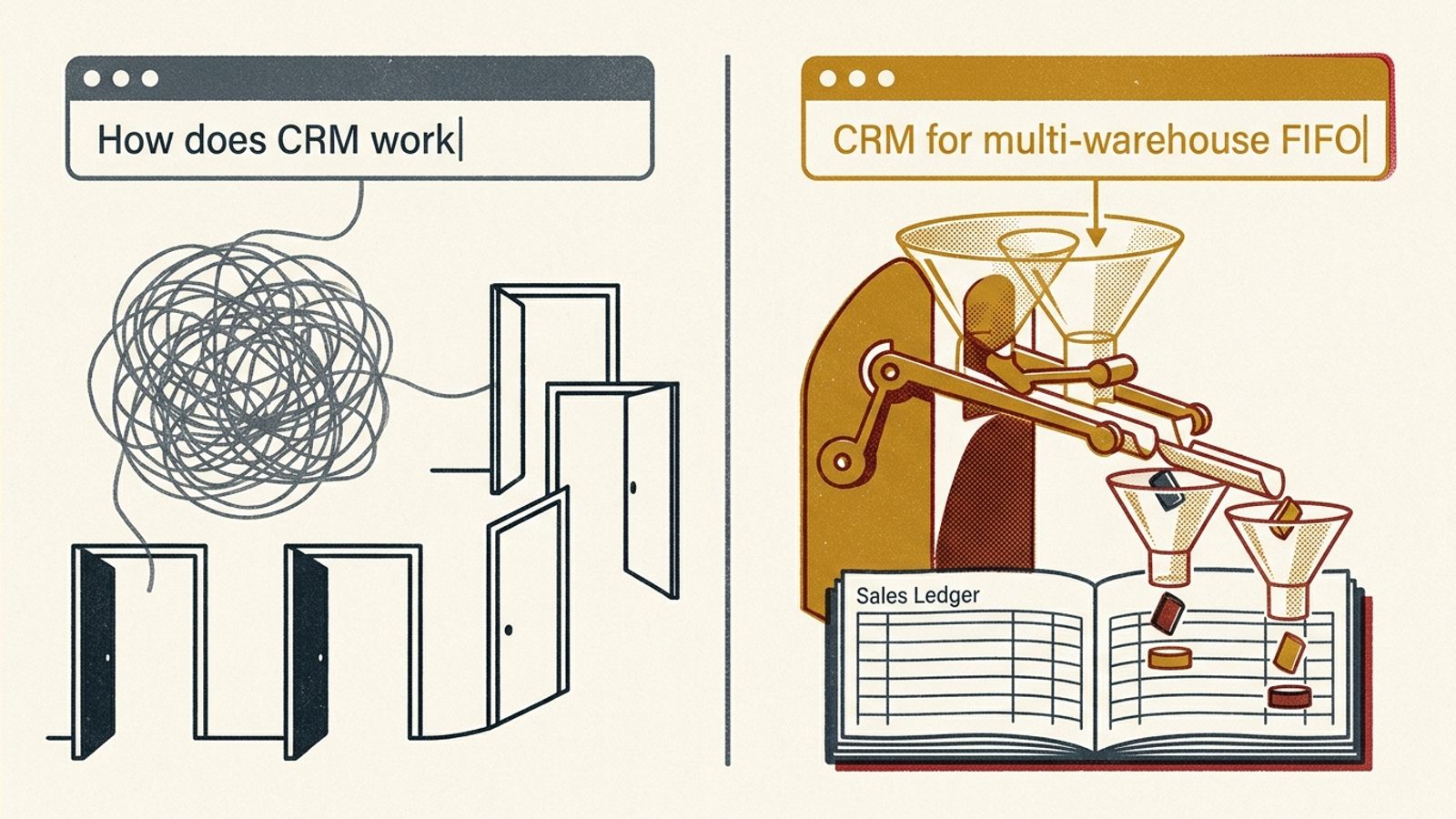
Skip the bloated head terms a standard keyword tool serves up, such as “best accounting software.” Buyers evaluating a purchase bring constraints: their stack, their budget, the workflow that keeps breaking, the competitor they might replace. Pull their wording from three places:
- Sales calls and lost-deal CRM notes: Find recurring objections, integration requirements, and comparison questions from last quarter.
- Conversational Google Search Console queries: Look for longer queries built around comparisons, specific capabilities, and pricing for a use case.
- Competitor-alternative searches: Look for queries pairing a rival with “alternatives,” “limitations,” “contract terms,” or “migration friction.”
Which questions should you delete?
A citation audit can swallow a week if you confuse curiosity with commercial intent. “What is double-entry bookkeeping?” may attract searches, but a citation in an AI textbook summary is not the same opportunity as an answer to a buyer’s workflow constraint.
Put each candidate through three tests:
- Constraint: Does it name an operating parameter, such as team size, technical stack, or budget tier?
- Vendor intent: Would a thorough answer need to evaluate specific providers?
- Pipeline consequence: If your main competitor is the only vendor cited, could that affect a genuine deal?
Delete questions that fail any test. Build a backlog of 30 to 50 high-stakes questions, not 500 topical curiosities. You will narrow that backlog to a smaller active audit once you know what is missing.
Step 2: How many answers should you sample?
Do not run one prompt in ChatGPT, see a competitor, and declare a crisis. One answer is a snapshot, not a pattern. Thinking Machines Lab’s testing produced 80 distinct completions from 1,000 runs of an identical prompt, even at zero temperature. Live retrieval adds changing indexes to the mix. Run each question five to ten times across clean browser sessions before you log a consistent miss.
Sample Google AI Overviews, Perplexity, and ChatGPT Search. A Google ranking does not tell you what the other surfaces will cite. In the Ahrefs study discussed here, only 28.6% of Perplexity-cited URLs ranked in Google’s organic top 10 for the query; ChatGPT’s overlap was roughly 8%. A Google-only audit leaves a large part of the buyer’s answer unseen.
For each run, record three separate observations:
- Raw citations: Which URLs appear as linked sources?
- Named mentions: Does the answer actually name your business?
- Positioning context: Is your brand presented as an option, or does the answer recommend a rival while using your page as support?
That last distinction catches ghost citations. In the study covered by Search Engine Land, roughly 40% of AI citations did not name the source brand in the answer text, rising to 52% on Perplexity. A footnote to your URL is not much comfort if the recommendation belongs to your competitor.
Step 3: What kind of miss are you looking at?
When an engine omits your domain, resist the urge to call every absence a content gap. Screpy’s breakdown of AI visibility gaps makes the case for classifying the failure before choosing a fix. I use three buckets:
- Type 1: Zero-Asset Gap. No indexed page addresses the prompt. If a buyer asks about your SOC 2 Type II compliance controls and you have never published a security overview, there is no relevant page to retrieve. This is the gap that calls for a new page.
- Type 2: Framing Gap. A page exists, but a competitor’s page directly compares the options against clear criteria while yours offers only isolated marketing copy. The question is not absent from your site; the useful comparison is.
- Type 3: Unliftable-Passage Gap. The page exists, the specifications are accurate, and the domain is indexed. But the answer sits in paragraph eight, behind a vague subhead, or across four disconnected sections. Rewrite the passage before you write another page.
Type 3 accounts for roughly 70% of the citation failures we review. It can look like a visibility crisis from a dashboard: your URL exists, yet a rival keeps appearing. On the page, the problem is often less dramatic. No single stretch of text answers the buyer cleanly without making the engine wade through unrelated copy.
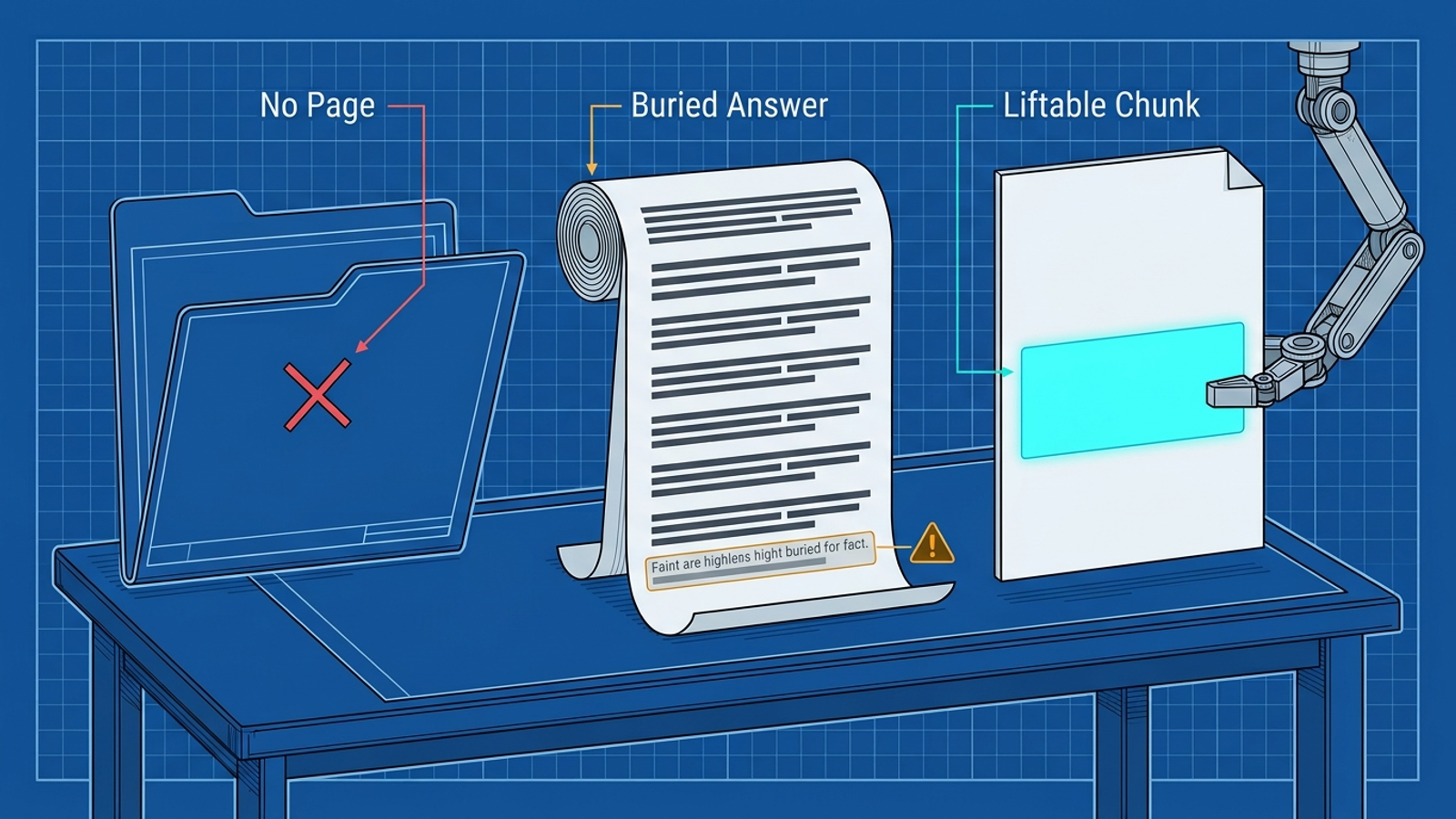
Classify the miss before assigning work. Otherwise, a paragraph problem turns into a two-month publishing plan.
Step 4: Which misses deserve attention first?
Do not sort the misses by traditional search volume. A broad prompt such as “best warehouse inventory software” might draw plenty of impressions. The buyer asking whether Fishbowl can manage FIFO cost layers across three Shopify locations without an ERP connector has a specific decision to make.
Score each missing prompt against three criteria:
- Average contract value: What is the deal worth when this requirement matters?
- Sales-cycle velocity: Could a clear answer help the buyer reach a decision sooner?
- Historical win rate: How often do you win when you can meet this requirement?
A question tied to a $30,000 annual recurring revenue deal deserves more attention than a broad definition prompt, even if the latter looks better in a keyword report. Prioritize the question closest to a purchase decision, then fix the page that ought to answer it.
Step 5: What should you change on the page?
If the answer is buried, rewrite the passage
For a Type 3 miss, skip the template redesign and the 2,000-word article. Add a self-contained answer where the buyer can find it early on the existing page. Geneo’s guidance on Q&A chunks describes 120- to 180-word blocks that can be extracted without depending on the rest of the page.
Build the passage in this order:
- Question header: Use an H2 or H3 that states the buyer’s question plainly, such as “Does [Brand] support multi-location inventory sync?”
- Direct answer: Put the bottom line in the opening 40 to 60 words. State the capability, the constraint, and the pricing logic where relevant. No preamble.
- Factual anchors: Add three or four bulleted specifications, latency numbers, or tier requirements already supported by the product information on the page.
- Boundary: Finish with the conditions under which the answer applies and who should look elsewhere.
Do not write a confident “yes” if the honest answer is “yes, on this tier and with this connector.” The boundary is part of the answer, not fine print to hide below it. Make the passage easy to lift and hard to misunderstand.
If the answer is unreadable, fix access first
A clean paragraph cannot help if a crawler receives empty HTML. Doomers.ai’s discussion of retrieval mechanics notes that bots such as OAI-SearchBot and PerplexityBot may not handle heavy client-side rendering like a human browser. Lead-capture gates and technical details buried in PDFs can create similar obstacles.
Before rewriting a page that appears to be missing entirely, inspect its server response. Check that the raw HTML contains the plain-text answer. If it does not, the first assignment belongs to whoever can make the content accessible, not to a copywriter polishing words the retriever cannot see.
What should the audit hand you?
Most “AI visibility tracking” software is monitoring software in an expensive coat. You pay $300 to $1,500 a month for a dashboard that samples 100 prompts, colors the misses red, and hands an already busy team an 80-row spreadsheet. Then the work begins.
A useful audit deliverable should identify the buyer prompt, the passage that lost, the competing passage that won, and the paragraph to rewrite. A red-and-green chart tells you that you are invisible. It does not tell you what to change. That is an expensive guilt trip.
Should you run this yourself or hand it off?
If you are a solo operator defending three core commercial questions and have a free Friday, do it yourself. Run five repeats across ChatGPT and Perplexity, inspect the relevant page, write the replacement answer in your CMS, and check the citations two weeks later. It is honest, useful work.
If you have 80 product variations, four regional service tiers, or nuanced integration questions arriving every day, manual checking becomes the bottleneck. A team can spend its time collecting screenshots and maintaining a sheet while the answers it wants to influence keep changing.
That execution problem is why we built groas as an autonomous growth engine rather than another advisory dashboard. Traditional agencies can bill a percentage of ad spend for periodic reviews; software can charge you to display recommendations you still have to implement. groas uses specialized AI models to execute search work continuously within client-defined guardrails, with action logs and a named human strategist accountable for direction. It runs on a flat monthly fee, with no setup fee or percentage-of-spend markup. The point is to spend less time interpreting a gap report and more time fixing what it found.
What goes in the audit sheet?
Use eight columns. Skip domain authority, estimated monthly search volume, and vanity rankings. Each field should help you decide what to fix or give someone enough context to fix it.
| Column | What to log | Why it matters |
|---|---|---|
| Buyer Prompt | The exact multi-clause question | Preserves the prospect’s wording |
| Deal Value ($) | Pipeline revenue associated with the question | Keeps commercial stakes ahead of curiosity volume |
| Engine Sampled | Google AI Overviews, ChatGPT Search, or Perplexity | Shows where the miss occurs |
| Winning Competitor | The competitor URL cited | Gives you the competing passage to inspect |
| Our Status | Cited, Ghost Citation, or Skipped | Separates attribution from retrieval problems |
| Gap Classification | Type 1, Type 2, or Type 3 | Determines whether to create a page or fix one |
| Target URL to Patch | Your closest relevant indexed page | Identifies where the answer belongs |
| Drafted Answer Chunk | The proposed 120–180-word passage | Turns the finding into an edit |
Keep the broader question backlog, but cap the active audit sheet at twenty high-stakes prompts. Five hundred rows turn into a strategy document that sits in Google Drive until the next reorg. Sort your active sheet by gap type, pull the Type 3 misses, and rewrite the direct answers on your top five pages before commissioning anything new.
The first thing to do today is not to buy another dashboard or book a 30-day content sprint. Open your CRM and read the closed-lost notes from your last five failed deals. Pick the technical objection or workflow question that stalled a buyer, then run it five times across ChatGPT and Perplexity. If your rival gets cited and your site does not, open the page where you already address that capability. Put an honest, declarative 50-word answer beneath a question header before you log off tonight.